

QuickStudy guide
The Tarot QuickStudy
Every Major Arcana card, the four suits and three easy spreads in one quick guide.
A friendly 101
A deck of pictures that helps you ask yourself better questions.
Never held a deck? Perfect. Here's how to find yours and pull your first card.
The basics
Tarot began as a card game in 1400s Italy. Fortune-telling came later, in 1700s France.
Tarot has 78 cards: 22 Major Arcana and 56 Minor Arcana in four suits. Oracle decks are freer, with any number of cards.
Most people read cards as prompts, not predictions. Pull one, look at the picture, notice what comes up.
Choosing
Want the classic system with loads of free help online? Tarot. Want simple and themed? Oracle.
A Rider-Waite-Smith style deck is the easiest to learn. Nearly every book and video uses it.
Moons, animals, angels, witches. The one you keep looking at is usually the one.
Using it
Shuffle any way you like while you think of a question, like "What should I focus on today?"
One is plenty. Lots of people pull a card each morning with coffee.
What do you notice in the picture? Then check the guidebook for its traditional meaning.
A short, friendly cheat sheet to keep next to your new thing. Print or PDF.
QuickStudy guide
Every Major Arcana card, the four suits and three easy spreads in one quick guide.
Starter kit
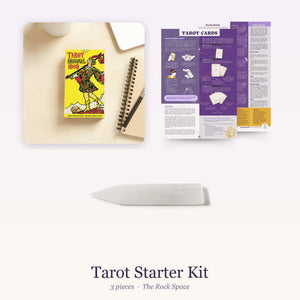
A beginner deck, its QuickStudy guide and a selenite bar to keep it all fresh. Everything you need for your first reading.
Good questions
Tarot always has the same 78-card structure. Oracle decks each make up their own.
Nope. Most readers use the pictures as prompts. The guidebook covers the meanings.
A Rider-Waite-Smith style deck, like Tarot Original 1909.
Only if you like the ritual. Some people shuffle well, knock three times or rest a crystal on top.
Traditionally it's about endings and change, not literal death. Most cards are less spooky than they look.
Wander a little